
The worst time for a school board or superintendent to make major new school safety policy may be immediately after a high-profile crisis in their own district. That is also when the pressure to act is greatest.
After a school shooting, stabbing, violent assault with a weapon, threat, or other serious incident, parents want answers, board members want visible action, and administrators face intense scrutiny. News coverage accelerates the pressure to do something immediately.
The temptation is understandable. It can also produce some of the weakest school safety decisions.
We have worked with many different types of school districts following shootings, stabbings, violent assaults, weapons incidents, and other serious events. A familiar pattern often follows: calls for more security hardware, tighter procedures, new weapons detection screening systems, additional technology, or some other highly visible response that school leaders can point to as proof that action is underway.
Sometimes those changes are justified.
But sometimes the result is security theater or what I call shiny object syndrome: highly visible target-hardening measures that may satisfy the immediate demand to show action without addressing the underlying risks, operational weaknesses, or human factors that matter most.
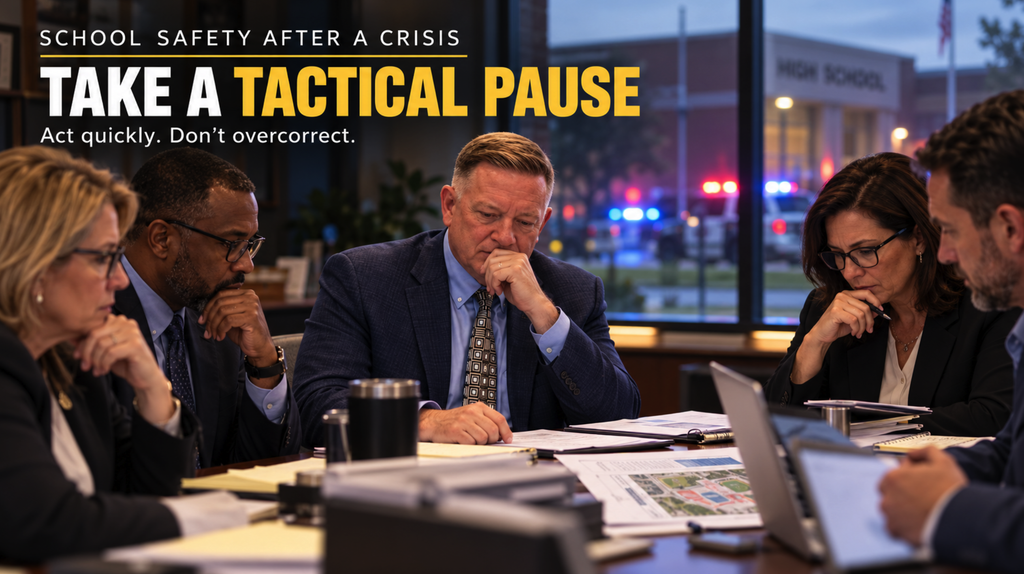
A Tactical Pause Is Not Doing Nothing
School leaders do not have the luxury of ignoring a serious incident. Immediate risks must be addressed. But there is an important difference between acting quickly and making major policy decisions too quickly.
A tactical pause means creating enough space to understand what actually happened, separate verified facts from assumptions, identify what worked and what failed, and avoid locking the district into a long-term policy or technology response before the picture is clear. That does not mean paralysis by analysis. It means disciplined leadership.
A tactical pause allows leaders to address urgent vulnerabilities while also asking more important questions about supervision, training, communications, emergency response, staff practices, leadership decisions, and implementation.
That is strategic school safety leadership under pressure.
Assess Before You Overcorrect
One of the strongest steps a district can take after a serious incident is to conduct a comprehensive school security and emergency preparedness assessment.
A meaningful assessment should go far beyond doors, cameras, locks, weapons detection systems, and other physical security measures. It should examine the full operating environment, including leadership, supervision, training, emergency preparedness, communications, school climate, transportation, extracurricular activities, technology, and actual day-to-day practices.
This is why when we do school security and emergency preparedness assessments, we assess the school – not just the building!
Many districts discover that their biggest problems are not found in written plans. They are found in the distance between paper and practice.
A policy may exist, a procedure may be written, and/or technology may be installed. Administrators may believe a process is being followed consistently. But what are staff actually doing? That is where implementation fidelity matters.
Beware the Shiny Object After a Crisis
After a highly publicized incident, the most visible solutions often rise to the top first: Parents may demand metal detectors and community members may call for armed personnel. Others may push for more cameras, panic systems, locked entrances, clear backpacks, new screening procedures, or tougher discipline policies.
These concerns should be heard and taken seriously. But public pressure should not become a substitute for professional analysis.
A district can spend heavily on a new layer of target hardening while leaving unresolved weaknesses in supervision, communication, staff response, training, emergency decision-making, or basic daily operations. That is the difference between comprehensive school safety and security theater or shiny object thinking. The most visible solution is not always the most effective one.
And rushed policy changes can create unintended consequences. New screening procedures can create large student queues outside the building. New locked-door requirements can interfere with supervision or emergency access. New technologies can create false alarms, staff workarounds, or misplaced confidence.
Well-intended decisions can backfire when leaders focus on how a policy looks rather than how it will actually work.

Strong Leadership Requires Restraint as Well as Action
Strong leadership after a crisis is not measured by how many new policies can be announced at the next board meeting. Sometimes leadership means resisting pressure to make a dramatic change before the district fully understands the problem.
It means being able to tell the community that immediate risks are being addressed, facts are being gathered, a comprehensive review is underway, and major long-term decisions will be based on evidence rather than emotion.
Clear strategic school safety communications are critical during this period. If leaders do not explain what they are doing and why, a measured response can easily be mistaken for inaction. A tactical pause should be active, not passive. It should lead to better questions, better analysis, and ultimately better decisions.
The Better Question After a School Crisis
The immediate question after a serious incident is often: What can we change right now?
The better question is: What do we know, what do we not yet know, what worked, what failed, and what changes will actually reduce risk without creating new problems?
That is the value of a tactical pause. It allows school boards and superintendents to move from reaction to analysis, from pressure to perspective, and from symbolic action to meaningful improvement.
The goal is not to delay. The goal is to avoid making tomorrow’s problems in the rush to solve today’s crisis.
For additional guidance, see Dr. Trump’s book, Proactive School Security and Emergency Preparedness Planning.


Dr. Kenneth S. Trump
President, National School Safety and Security Services
Dr. Kenneth S. Trump is President of National School Safety and Security Services, an independent, non-product-affiliated school safety consulting firm. With more than 40 years of experience in PreK–12 school safety, security, and emergency preparedness, he provides independent analysis and strategic guidance to school leaders nationwide.