
We’ve substantially updated our independent guide to help school leaders make better-informed decisions before hiring a school safety or security consultant.
The wrong school safety consultant can create as many problems as they promise to solve.
Today’s school safety consulting marketplace includes experienced professionals, but also self-proclaimed experts, security product vendors, individuals with questionable credentials, and people whose backgrounds may not translate to the everyday realities of PreK–12 schools.
For superintendents, school boards, and other administrators, selecting a consultant is more than a purchasing decision. It is a school safety leadership and risk management decision.
Look Beyond the Title, Sales Pitch, and Credentials
A compelling personal story, impressive title, or polished presentation does not automatically translate into the experience and judgment needed to evaluate school safety and security.
School leaders should ask tougher questions before engaging outside consultants:
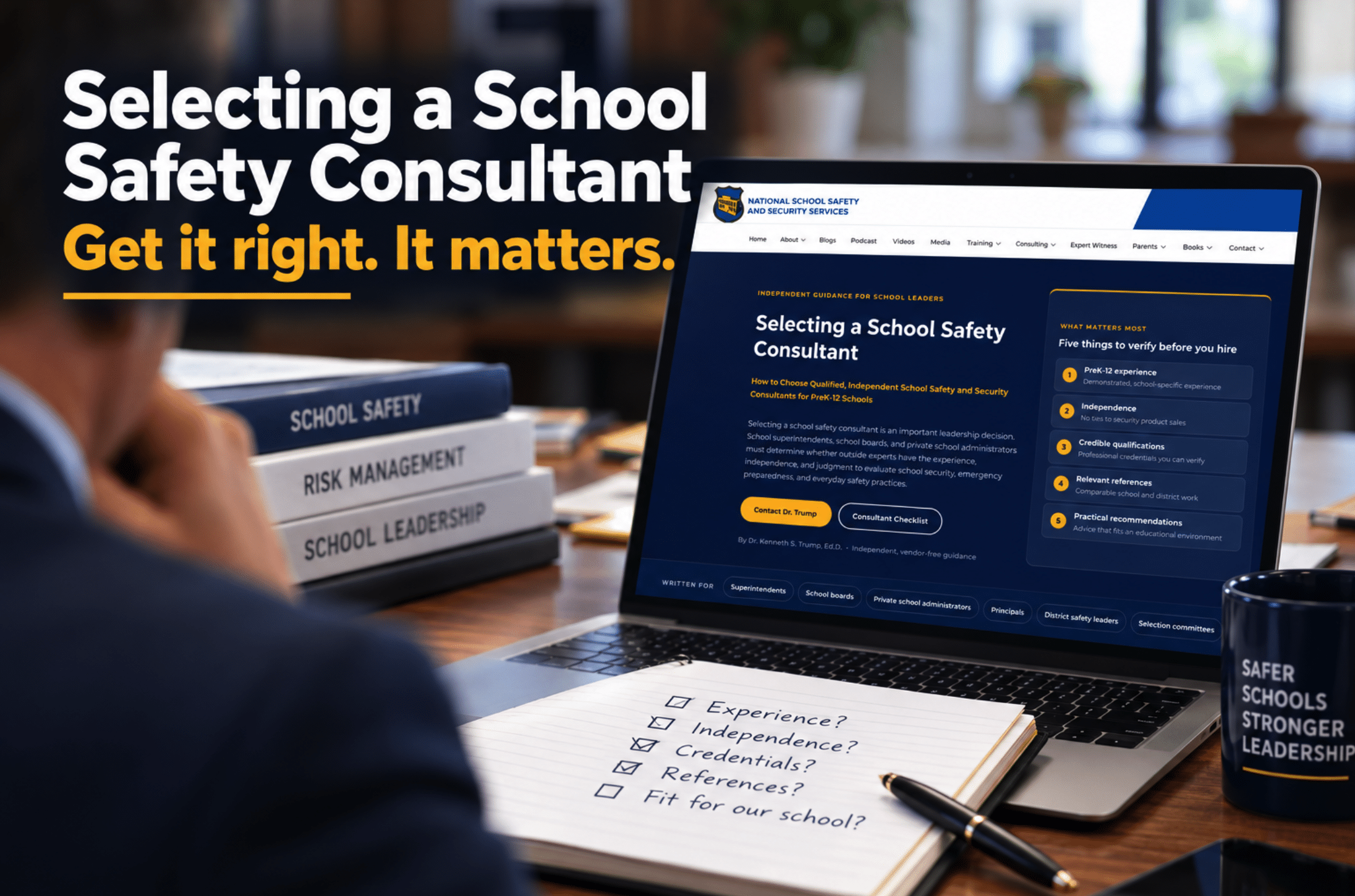
- Experience: Does the consultant have substantial, relevant PreK–12 school safety experience?
- Independence: Are recommendations influenced by security product sales, vendor relationships, or financial interests?
- Qualifications: Can professional credentials, references, and actual school consulting experience be verified?
- Practical judgment: Will recommendations reflect the realities of school operations, staff responsibilities, educational environments, and available resources?
- Accountability: Who will actually conduct the work, and can they explain and defend their findings and recommendations?
New and Updated Independent Guidance for School Leaders
We’ve substantially refreshed our guide, Selecting a School Safety Consultant, to help school administrators and selection committees better evaluate qualifications, independence, potential conflicts of interest, and the quality of proposed services.
The guide also reinforces a fundamental principle: School safety expertise requires more than knowledge of security equipment or experience with a single critical incident. It requires an understanding of how school leadership, people, policies, supervision, preparedness, and security measures work together in real educational environments.
The consultant you select should be part of your risk management strategy, not another risk to manage.
School Safety Consultant FAQs
What qualifications should a school safety consultant have?
A qualified school safety consultant should have relevant PreK–12 experience, demonstrated school security and emergency preparedness knowledge, credible references, appropriate professional qualifications, and the ability to produce practical recommendations. Schools should evaluate the qualifications of the specific individuals performing the work, not simply the consulting company’s reputation.
Why should schools consider an independent school security consultant?
An independent school security consultant who is not financially affiliated with security product manufacturers or vendors can evaluate school safety needs without a sales incentive to recommend particular products. Independence supports objectivity, but it should be evaluated alongside experience, qualifications, methodology, and professional judgment.
Can a former police officer or military professional be a qualified school safety consultant?
Yes. Law enforcement and military experience can provide valuable expertise, but those backgrounds alone do not establish competence in PreK–12 school safety. Schools should seek evidence of additional experience with school operations, student supervision, educational leadership, emergency preparedness, and the specific services being requested.
What is the difference between a school safety consultant and a security equipment vendor?
A school safety consultant evaluates risks, operations, leadership practices, emergency preparedness, and security needs. A security equipment vendor primarily provides or sells particular products or services. Some providers perform both roles, making disclosure of commercial relationships and potential conflicts of interest important.
How should a school district compare school safety consultant proposals?
Compare the proposed methodology, scope of work, school-specific qualifications, independence, assigned personnel, references, deliverables, and ability to produce actionable recommendations. Price matters, but selecting the lowest bidder without evaluating qualifications and scope can undermine the value of the engagement.
Read the Full School Safety Consultant Guide
Read our updated independent guide:
For additional guidance, see Dr. Trump’s book, Proactive School Security and Emergency Preparedness Planning.


Dr. Kenneth S. Trump
President, National School Safety and Security Services
Dr. Kenneth S. Trump is President of National School Safety and Security Services, an independent, non-product-affiliated school safety consulting firm. With more than 40 years of experience in PreK–12 school safety, security, and emergency preparedness, he provides independent analysis and strategic guidance to school leaders nationwide.