
The horrific elementary school shooting in Bend, Oregon, is another heartbreaking reminder of the stakes involved in protecting our schools. Our thoughts are with the victims, their families, educators, and the entire school community.
In the aftermath of school tragedies, superintendents, principals, school boards, and safety officials face extraordinary pressures to provide answers, reassure families, address public concerns, and make consequential decisions, often before all the facts are known.
These are the moments when strategic school safety leadership matters most.
Moving The Focus Beyond Reactive School Safety Leadership
Effective school safety leadership involves much more than emergency plans, compliance requirements, and security technologies. It requires critical thinking, sound judgment, meaningful relationships, and a culture of safety in which established policies and procedures are consistently implemented.
It also requires recognizing that what districts have on paper, what administrators believe is happening, and what actually occurs in schools can be three very different things. Those disconnects can expose significant safety vulnerabilities and potential liabilities.
During difficult times, school leaders must distinguish situations requiring immediate protective action from those warranting a tactical pause to verify facts, evaluate options, and avoid decisions driven primarily by emotions, political pressures, or demands for visible action.
Greater emphasis must be put on proactive strategic school safety leadership, not simply reactive.
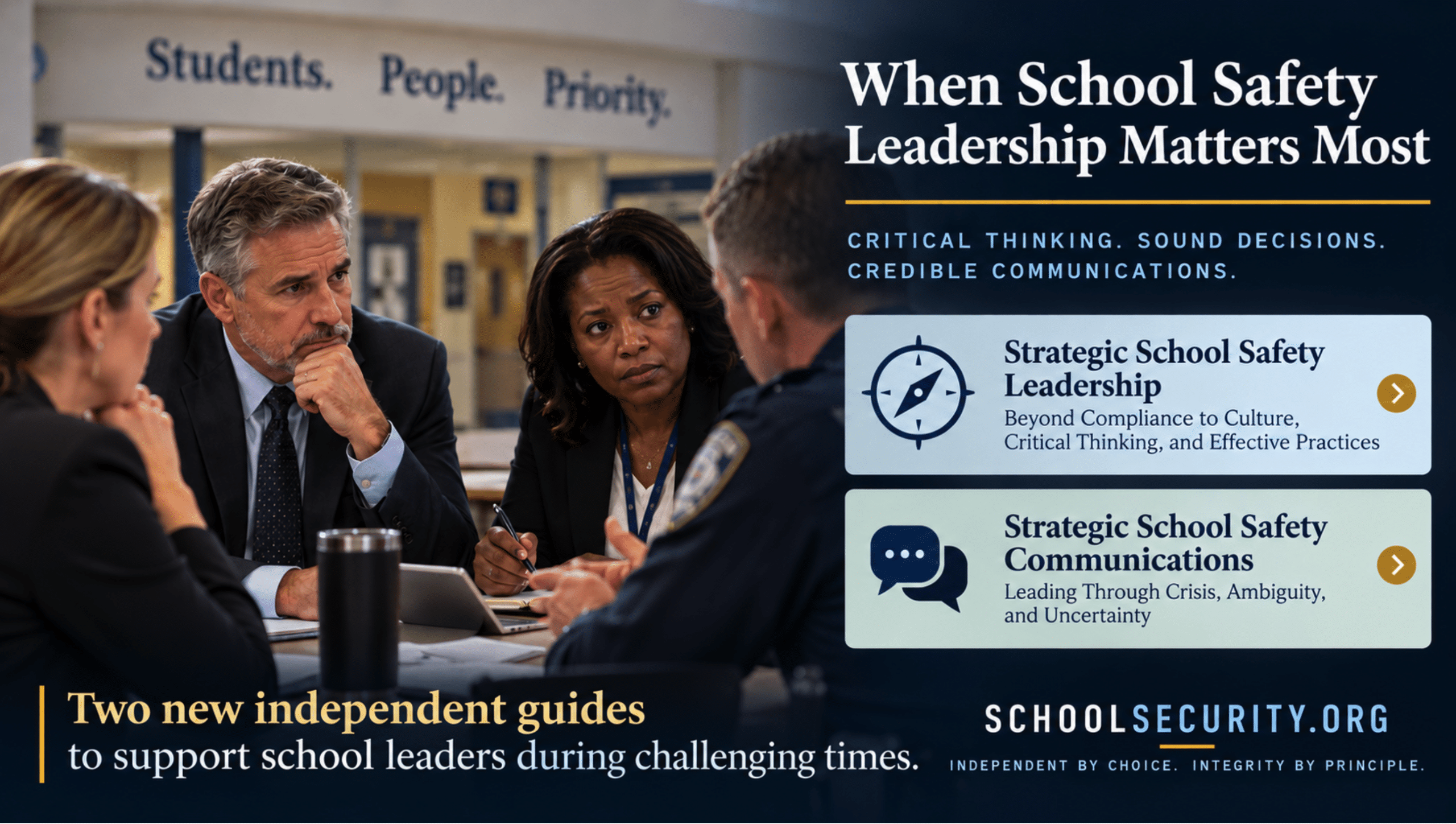
Introducing Our New Strategic School Safety Leadership Guide
Drawing upon more than four decades of K-12 school safety experience and my doctoral research at Johns Hopkins University on strategic school safety leadership, we have published a new independent cornerstone resource:
The guide examines how school administrators can move beyond compliance checklists and written policies to strengthen organizational culture, improve fidelity of implementation, and make more informed decisions.
Among the leadership challenges addressed are identifying disconnects between policies and actual practices, evaluating security products and vendor influence with independent judgment, building meaningful stakeholder relationships before crises, and communicating transparently, authentically, and in a timely manner.
The focus is not simply on responding effectively when something goes wrong, but on strengthening the leadership, organizational systems, and everyday practices that should already be in place.
Strong School Safety Leadership Requires Credible Communications
Strategic leadership and effective communications are inseparable, particularly when information is incomplete, emotions are high, and public scrutiny intensifies. School leaders must be able to acknowledge concerns, communicate uncertainty responsibly, and maintain community trust without becoming defensive or rushing to conclusions.
As a companion resource, we encourage school administrators to revisit our recently released Strategic School Safety Communications: Leading Through Crisis, Ambiguity, and Uncertainty guide.
Together, these independent, non-product-affiliated resources offer practical guidance for school leaders navigating increasingly complex school safety responsibilities.
School Safety Is What We Actually Do
No security product, emergency plan, or compliance checklist can substitute for effective leadership, just as polished communications cannot compensate for weak practices or a lack of community trust.
Strategic school safety leadership requires effective communications, and credible school safety communications must reflect strong leadership.
Ultimately, school safety is not what we say we do. It is what we actually do, consistently, when it matters.


Dr. Kenneth S. Trump
President, National School Safety and Security Services
Dr. Kenneth S. Trump is President of National School Safety and Security Services, an independent, non-product-affiliated school safety consulting firm. With more than 40 years of experience in PreK–12 school safety, security, and emergency preparedness, he provides independent analysis and strategic guidance to school leaders nationwide.